Implicit Surfaces R&D
This methods are based on "converting" a surface definition from explicit to implicit and vice versa.
For example, I begin from explicit (usual polygonal) surface and measure a signed distance to it from an arbitrary point. Then, I perform some computations (like boolean, blending, etc). Finally, I take a new polygonal surface, that is smooth and topologically equivalent to my implicit result and iteratively push down it's points to zero level (by gradient multiplied by SDF).

Examples: Blending the torus and the dodecahedron.

Examples: Same as previous, but another blend function (the first one is subtractive).
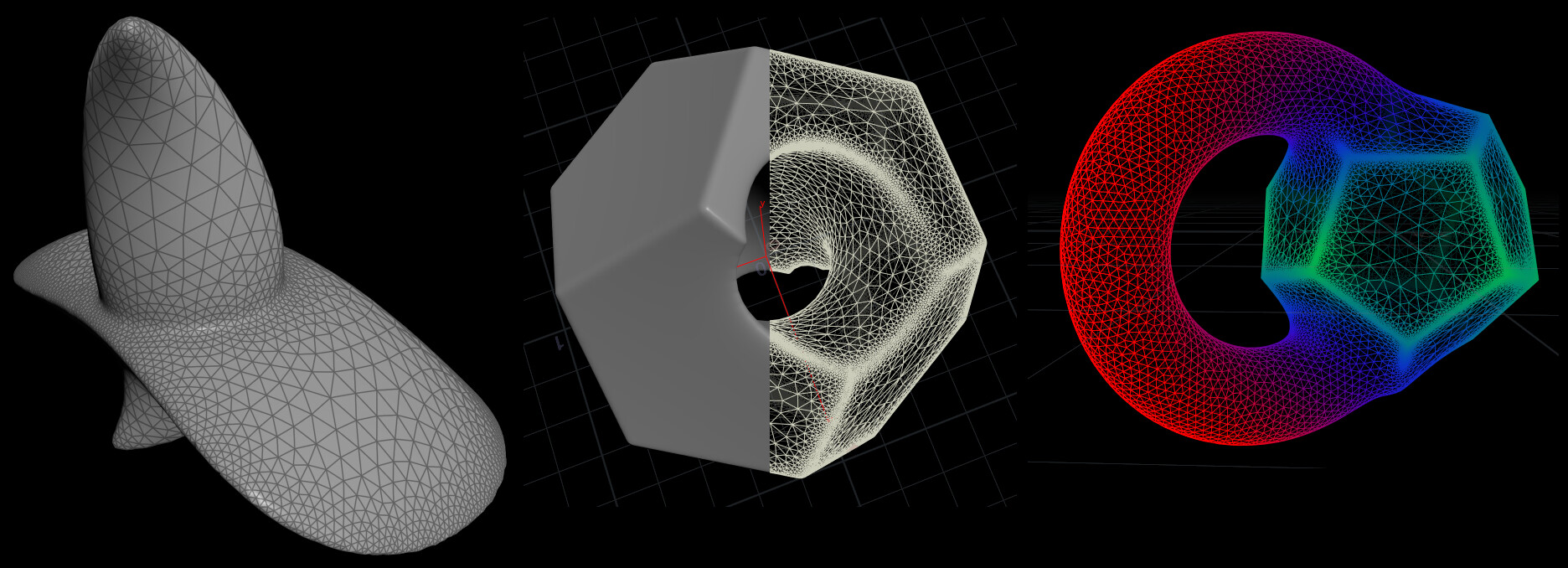
The mesh on the SDF zero level.

The deformed plane grid with added thickness and border profile. Not a mesh, but a VDB volume using here for visualization.

Start with the one-sided mesh, then add thickness and profile. On the third picture, the thickness various by attribute. VDB visualization.